Tigers Football School Spirit
As someone who’s stitched school spirit designs on everything from newborn onesies to boutique aprons—and sold hundreds of custom embroidered tote bags through my Etsy shop—I opened Tigers Football School Spirit with a very specific question: *Will this hold up under needle, thread, and real-world expectations?*
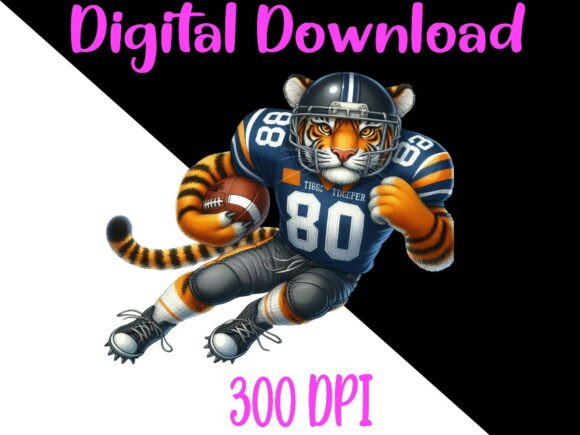
First impression? It’s bold, spirited, and unmistakably collegiate—without leaning into cartoonish cliché. The tiger graphic reads as strong but friendly, not aggressive; the football element is integrated cleanly, not tacked on. There’s no excessive linework or micro-detailing that would vanish in satin stitch. That alone tells me this was designed with embroidery in mind—not just digital display. As an Illustrations asset, it’s built for adaptability: clean edges, intentional negative space, and a composition that doesn’t rely on subtle gradients or soft shadows (which don’t translate to thread).
I tested it by scaling it down for a baby cap and up for a full-back sweatshirt panel—both common requests in my craft business. Because it’s a transparent PNG at 300 dpi, resizing behaved predictably: no pixelation, no jagged edges. But here’s what matters more than resolution: how the shapes hold up when converted to an embroidery file. I ran a quick vector trace in my digitizing software, then simulated stitch paths. The tiger’s eye, snout contour, and football laces stayed legible even at 2.5 inches tall—no risk of those details collapsing into a muddy fill stitch blob. That’s rare in generic graphics labeled “embroidery-ready” but delivered as flat art.
This design shines brightest on medium-weight fabrics where structure supports crisp stitching: canvas tote bags, cotton-poly blend sweatshirts, twill aprons, and tea towels. On a recent client project—a set of embroidered kitchen towels for a high school booster club—I placed Tigers Football School Spirit off-center, sized to 4.25 inches wide. The result looked professional, balanced, and instantly recognizable—not “designed by committee,” but hand-chosen and thoughtfully applied. Customers commented on how “clean” and “school-proud” it felt—exactly the emotional resonance you want from spirit wear.
Where to pause before stitching? First, avoid using it *as-is* on highly textured fabrics like terry cloth or bouclé knit. Those surfaces swallow fine detail, and without knowing the original vector paths, you can’t easily simplify the design for heavy texture. Second, skip it for curved surfaces—like the front of a structured baseball cap—unless you’re willing to manually adjust stitch angles and density. The current layout assumes a flat plane; the tiger’s shoulders and football curve may pucker or distort without re-digitizing.
Also tread carefully on thin or stretchy fabrics—think lightweight tees or baby rib knit. Without proper cutaway stabilizer and careful hooping, the fill areas (especially the tiger’s chest or football surface) can shift or tunnel. And while the transparent background is perfect for mockups and layered digital previews, remember: embroidery machines don’t see transparency. You’ll need to define clear stitch boundaries—so inspect corners and inner cutouts closely before sending to your machine.
For Etsy sellers and small shop owners, Tigers Football School Spirit works well as a core design asset—but only if you treat it like raw material, not a finished product. It’s not a plug-and-play machine embroidery design; it’s a high-res digital embroidery file foundation. That means your value-add comes in thoughtful digitizing, smart color pairing (try burnt orange thread on navy sweatshirts—it pops without screaming), and consistent presentation across your listings. I used it in three different printable mockups—tote bag, crewneck, and pillow cover—and each felt cohesive, not repetitive. That consistency builds brand trust faster than any marketing copy.
One real-life test that sealed my judgment: a holiday gift order for a Tigers fan’s 5-year-old. I paired Tigers Football School Spirit with a simple “Future Star” script below it on a grey fleece blanket. Stitched at 3.75 inches wide, the tiger read clearly—even from across the room—and the football added just enough sporty charm without overwhelming the childlike scale. No one mistook it for clipart. That’s the difference between a decoration and a handmade product with intention.
Practical notes I’d share with fellow designers and craft entrepreneurs:
- Always test on scrap fabric first—especially with dark or textured substrates. What looks sharp on screen often needs adjusted thread contrast in real life.
- Review stitch density in your digitizing software. High-density fills may require tear-away stabilizer; low-density running-stitch outlines work better on delicate items like baby embroidery.
- Confirm hoop size compatibility before committing to large placements—e.g., full-front sweatshirt layouts often need 5×7" or larger hoops.
- Inspect small details at 200% zoom: the football laces, tiger’s whiskers, and letterforms (if any text is added later) must survive reduction.
- Test black-and-white mockups—they reveal contrast issues invisible in color previews.
- Compare light vs. dark fabric backgrounds in your design workflow. A transparent PNG gives flexibility, but thread choice determines whether the spirit feels vibrant or washed out.
- Use appropriate stabilizer: cutaway for knits, tear-away for stable wovens, and fusible for lightweight layers like patch backs.
- Verify licensing terms before selling finished items or bundling this as part of a commercial embroidery kit. Since this is a Graphics asset, not a pre-digitized file, usage rights depend on the seller—not the format.
In short: Tigers Football School Spirit isn’t flashy—but it’s reliable. It won’t wow with novelty, but it delivers clarity, versatility, and quiet confidence across embroidered patches, custom apparel, personalized gifts, and small shop merchandise. It respects the craft instead of shortcutting it. And in a market flooded with overdesigned, under-tested graphics, that’s exactly the kind of design assets that earn repeat customers, build boutique credibility, and turn a simple embroidery project into a finished product people proudly carry, wear, and gift.